







XYZ Paris 2025 : How AI is reinventing the enterprise – Become a visionary !

Keynote by Morand Studer at XYZ Paris 2025
During XYZ Paris 2025, Morand Studer shared a strong conviction : Artificial Intelligence is no longer simply a technological evolution, but a strategic transformation challenge for organisations.
While recent advances in generative AI have democratised access to these technologies, significant maturity gaps still remain between companies. Some organisations are experimenting without a clear business trajectory, while others are already reshaping their operating models around AI driven transformation.
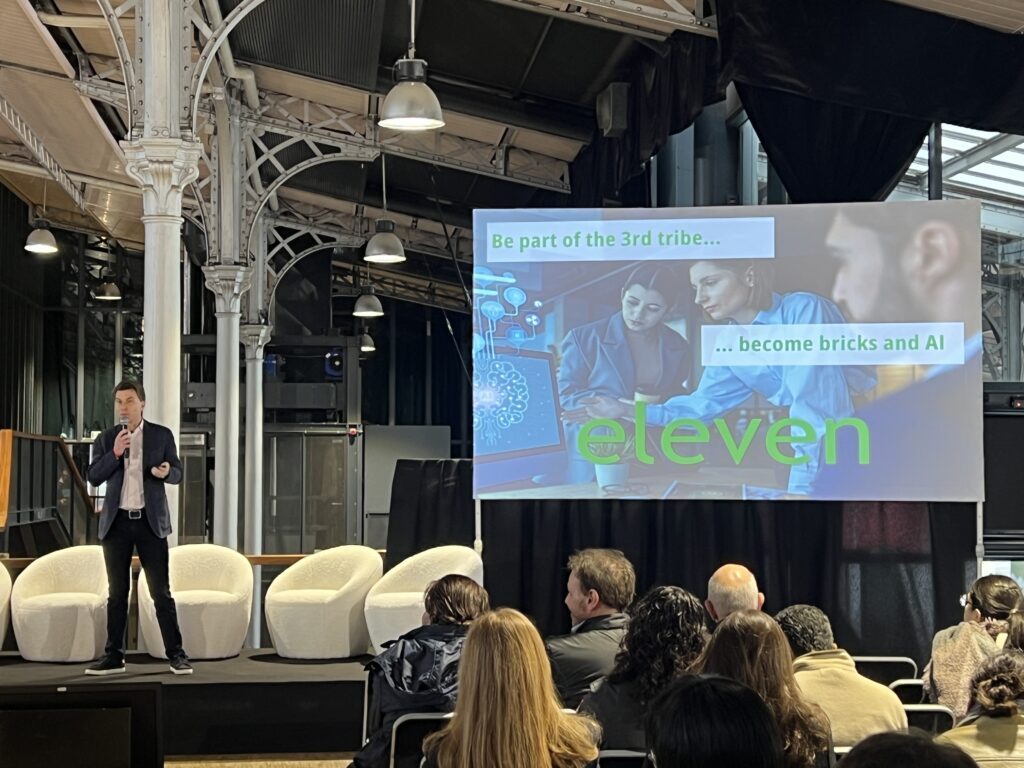
Three approaches to AI adoption
Across the projects conducted with major organisations, three main attitudes towards AI are emerging :
1 - Opportunistic organisations
Some companies still view AI as a miracle solution capable of rapidly transforming their business without fundamentally rethinking processes or organisational structures. These approaches often lead to isolated experiments that struggle to scale.
2 - Cautious organisations
Others fully understand AI’s potential but face difficulties scaling initiatives. Common barriers include identifying the right use cases, aligning stakeholders, technological constraints and insufficient governance structures.
3 - Transformational organisations
Finally, some companies are already using AI as a genuine operational transformation lever. They integrate AI directly into their core business processes, structure their data foundations and develop solutions tailored to their specific strategic challenges.
These organisations are currently capturing the most significant gains in productivity, service quality and competitiveness.
Why many AI projects still fail
Despite the enthusiasm surrounding AI, many initiatives still struggle to deliver tangible results. Several recurring issues frequently emerge :
- Generic tools poorly adapted to business realities
- Insufficient integration into operational processes
- Weak data quality or governance
- Unrealistic expectations regarding current model capabilities
As highlighted by Morand Studer during his keynote, organisations that succeed with AI are above all those that approach it pragmatically, methodically and with a strong business driven mindset.
Two key levers for successful AI transformation
1. Embedding AI at the core of business processes
The most successful AI initiatives do not simply layer AI onto existing processes. They fundamentally redesign workflows around the new capabilities enabled by these technologies.
This notably requires :
- Connecting AI models directly to business data
- Adapting tools to real operational use cases
- Prioritising tailored approaches when strategic differentiation is critical
Example :
A B2B company deployed an AI solution dedicated to analysing and responding to tenders. The result : response times divided by six and a significant increase in win rates.
2. Preserving control over expertise and data
AI is progressively becoming a strategic asset. Organisations must therefore carefully balance off the shelf solutions and internally developed capabilities.
The most advanced companies are now focusing on :
- Securing sensitive data
- Leveraging internal business expertise
- Reducing dependency on external platforms
- Building AI architectures aligned with governance and sovereignty requirements
Example :
In the luxury sector, a brand developed an AI assistant designed to support sales advisors with product recommendations while preserving a highly personalised customer experience.
AI use cases are now concrete and industrialised
AI applications are now moving far beyond experimentation and generating measurable impact across multiple industries :
- Construction & engineering : Automated generation of technical plans using tools such as AutoCAD and Autodesk Revit, reducing tasks that previously took weeks to only a few minutes.
- Retail & luxury : AI powered sales assistants enabling highly personalised recommendations and enhanced customer experiences.-
- Industry & supply chain : Predictive maintenance solutions reducing certain operating costs by up to 40 %.
The key success factors for AI transformation
Beyond the technologies themselves, several factors appear decisive for successful AI transformation :
- Identifying high value business use cases
- Starting with targeted and measurable pilots
- Training and acculturating teams
- Establishing clear governance around data and models
- Maintaining a long term transformation vision
AI : a strategic challenge beyond technology
AI should no longer be viewed as a standalone technological innovation or an isolated experimentation topic. It is progressively becoming a core component of operating models and long term competitiveness.
The organisations that succeed will be those capable of combining strategic vision, technological mastery and concrete business transformation.