







Nicolas Réquillart-Jeanson : the key role of the Operating Partner in private equity

Nicolas Réquillart-Jeanson speaks candidly about his role as an Operating Partner within Siparex. A relatively recent profession in France, but one that is becoming increasingly central to the economic model of private equity.
AI roadmaps, operational levers, change management, portfolio networking, recruitment of key executives… he explains his support methodology through concrete examples.
How would you define the role of an Operating Partner today ?
An Operating Partner is an employee of the fund entirely dedicated to operationally supporting the management teams of portfolio companies in which we have invested.
Historically, profiles tended to be generalists. Today, the trend is clearly moving towards specialisation, with Operating Partners focusing on one or several value creation levers.
At Siparex, for example, we recently recruited a Climate Operating Partner. Our mission is to help companies decarbonise their activities, improve biodiversity impact and progress on social and HR topics. To our knowledge, this is a first in the market.
What are the main levers you activate ?
We have structured our support around four key operational levers :
- IT, Digital, Data and AI : covering scalability challenges, tooling (ERP, CRM, APIs) and, of course, the AI transformation of business models. The objective is to put technology at the service of SMEs
- Performance : supporting growth, acquisition, retention, brand awareness, sales development, cost optimisation, subsidy identification and, in some cases, business model diversification
- HR and governance : ranging from executive committee structuring (CFO, CEO recruitment, etc.) to strengthening boards of directors through independent board members and implementing value sharing plans
- Climate and ESG : defining decarbonisation roadmaps, conducting ESG due diligence and monitoring related KPIs to steer ESG transformation trajectories within portfolio companies
Digital and AI transformation have become central themes. How do you support your portfolio companies on these topics ?
We launched a structured programme called “IAction Booster”. Every portfolio company is encouraged to build its own AI roadmap.
Even before due diligence, we integrate the analysis of this new risk dimension, both on the business model and on operational processes, directly into our investment decision framework.
This approach is built around three pillars :
- First, awareness and education : every six months, we gather more than one hundred portfolio executives to share operational feedback, key success factors and strategic risks. Clément Téqui recently spoke at one of these sessions
- Second, framing : we help companies identify challenges, prioritise initiatives and formalise action plans, often with the support of consultants
- Finally, implementation : which can be delivered either internally or with external partners, depending on available resources
We have also developed an AI and Data playbook accessible to all portfolio companies. Some use it autonomously, while others prefer full or partial support.
This is why we particularly value partners capable of operating in a true 360 degree approach, combining strategic framing with operational execution, as is the case with Eleven.
What are the most common barriers to AI and data adoption ?
- Change management : AI often raises questions, fears or even resistance. To succeed, companies must start from everyday pain points and concrete use cases, whether for employees or customers.
- Scalability : some projects are technically poorly designed. Inadequate architecture choices, unstructured data or unsuitable technologies can slow down adoption and deployment.
- Purpose and ROI : AI initiatives must be economically relevant. Without a clearly identified return on investment from the outset, transformation efforts are not sustainable.
You mentioned concrete examples. Could you share a few ?
Of course.
The first example concerns MobSuccess, a tech company we support. Thanks to its AI roadmap :
- The company saved more than 10,000 working hours on day to day tasks through more precise targeting and automated processes
- It also initiated a business model pivot, with a target of more than €1 million in additional revenue starting this year
The second example is Top Chrono, a last mile delivery player.
We launched a logistics route optimisation project :
- 3 months of development
- €200,000 investment
- Several million euros in savings generated and reinvested into internal transformation
But that is not all. The solution also automates dispatcher tasks, a position that had become increasingly difficult to recruit for. As a result, teams can now focus on higher value activities such as customer service and training.
How do you assess the digital maturity of the companies you support ?
We monitor their maturity evolution every six months through our “IACTION” diagnostic framework, combined with ongoing discussions and feedback.
Our regular executive clubs also provide real time field insights.
Most importantly, we strongly embrace the ecosystem approach. With more than 200 portfolio companies, we have created several thematic communities, including CEO, IT/Data and ESG clubs, as well as informal communication channels such as WhatsApp groups, to encourage the sharing of best practices. And it works extremely well.
And regarding value creation management, what is your approach ?
As soon as a fund invests in a company, alignment with management teams becomes essential. Incentive mechanisms help reinforce this alignment.
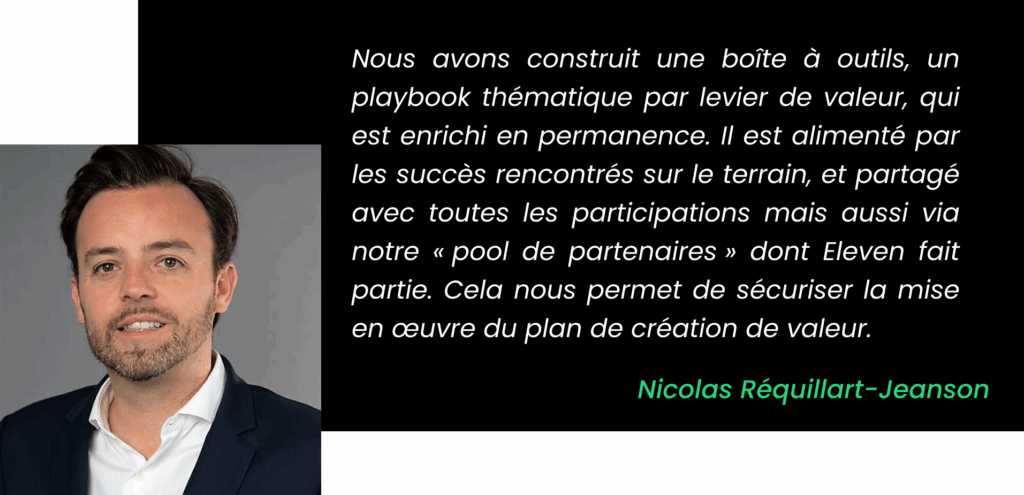
In practical terms, when we enter a company, we begin with a diagnostic assessment that we break down into “streams”, meaning operational action plans.
These plans are monitored through quarterly business reviews, which are clearly distinct from financial reviews. An Operating Partner works with and for management teams, not as a co pilot of the company.
What trends do you see emerging in this profession ?
We are witnessing increasing specialisation among Operating Partners. More and more funds are internalising these profiles, typically professionals between 35 and 55 years old.
But beyond technical expertise, I believe the role must evolve towards a coaching posture. The real impact lies in transferring and embedding skills so they become fully adopted, embodied and sustainable within the company itself.
A good Operating Partner is someone who “makes others better”, not someone who does the work in their place.
And regarding the integration of data and AI into private equity ?
It is already becoming an obvious evolution across many funds.
I am convinced that in the coming years, 100 % of private equity firms will integrate data and AI into their processes, both to improve operational efficiency and identify higher quality deals, but also to transform the business models of their portfolio companies.
To learn more, visit Siparex or contact Nicolas Réquillart-Jeanson.
To explore these topics further and identify the opportunities and impacts relevant to your organisation, contact our expert : Clément Tequi (Principal Eleven)