







New paradigms in the mobile ecosystem, calling for new development standards
Before the smartphone era, innovation in the telecommunications industry was primarily driven by network capabilities (2G, EDGE, GPRS, 3G, etc.) and by the technological limitations of devices themselves, including battery life, size, cost, screen quality, camera performance and embedded connectivity technologies.
At that time, mobile usage was mainly limited to voice calls and SMS. Innovation was incremental in nature, progressively leading to smaller, more affordable and more widely adopted mobile phones thanks to declining production costs among manufacturers.
In response to this technological evolution, telecom operators separated product, technology, offer and sales dimensions when designing their service offerings.
New network capabilities enabled companies such as HTC and Research In Motion to launch a new category of device as early as 2002 : the smartphone. Initially targeted at professionals, this innovation represented a major shift by introducing mobile internet usage.
This disruption became mainstream in 2007 with the arrival of the smartphone for the general public. With the iPhone, Apple commercialised an integrated solution combining a product focused on user experience, data centric offers and customer support throughout the acquisition journey.
As smartphones became mainstream, they dramatically expanded the range of available mobile usages : web content, multimedia streaming, instant messaging and gaming. For example, Candy Crush Saga exceeded 100 million daily users, while WhatsApp reached 900 million downloads.
This explosion of usage created fertile ground for innovation across services, technologies and mobile networks. The arrival of the smartphone marked the first major technological singularity, fundamentally reshaping consumer expectations regarding mobile experiences.
However, the development of these new usages also created friction for consumers. Operator offers were not differentiated according to devices and intended usages. Data plans were sometimes bundled with phones lacking internet access, while smartphones were sold with offers excluding data usage, resulting in unexpected charges and dissatisfied customers.
This situation pushed operators to ensure stronger alignment between devices, offers and intended customer usage. To achieve this, they began integrating product, technology, offer and sales dimensions when designing services. Unlimited data plans associated with smartphones became a key response to these new usage patterns.
The commercial success of smartphones also accelerated technological innovation in batteries, miniaturised sensors, connectivity technologies and screens, while reducing hardware costs. This led to the diversification and proliferation of mobile devices and connected objects.
Gartner forecasted an acceleration of this trend, estimating that 25 billion connected devices would shape consumers’ daily lives by 2020.
The multiplication of mobile devices introduced entirely new paradigms :
- Users no longer own a single mobile device, but rather a collection of devices : personal and professional smartphones, connected objects and tablets. Shared devices, such as family tablets, also introduce new complexity in both individual and collective user experiences, as well as in service offerings and administration models.
- New usages are emerging with the multiplication of mobile devices : from smart homes and connected cars to wearables and B2B applications. In a multi device environment, this diversity of usage creates complexity for consumers, who may fulfil the same need through different devices.
- Connectivity technologies are diversifying. New radio protocols such as Sigfox and LoRa have emerged to address the different usage requirements of connected devices. Home networking protocols have also multiplied, with technologies such as Zigbee, Z-Wave, Wi Fi and Thread competing to establish their standards. This growing diversity creates confusion for consumers, who often struggle to understand compatibility between devices and technologies.
- Platforms and ecosystems are multiplying. Some companies are developing web platforms designed to unify compatibility between devices using different connectivity technologies. Large players, particularly the Google, Apple, Meta and Amazon ecosystems, are building integrated environments to simplify technological complexity and incompatibility between connected devices. However, the growing number of ecosystems introduces additional complexity for consumers, who increasingly struggle to understand which devices and ecosystems are compatible with their own connected environment.
- Data consumption plans are also becoming more complex. Today, consumers typically subscribe to a mobile plan linked to a smartphone or tablet. As the number of connected devices per user increases, these multi SIM offerings are likely to become increasingly sophisticated.
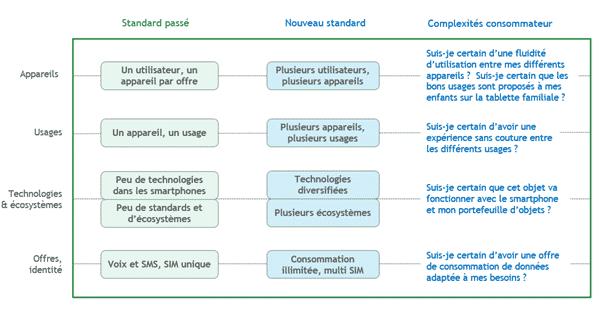
Faced with these disruptive technological innovations, we are entering a new reality where multiple consumers use multiple devices, multiple technologies and multiple services within a highly competitive and multi ecosystem environment.
The complexity generated by these disruptions, both in terms of technologies and usages, is far greater than during the emergence of smartphones.
Consumers, overwhelmed by this new reality, increasingly gravitate towards ecosystems with the strongest reputation, such as Apple. This defensive behaviour represents a risk for telecom operators, which could gradually lose direct ownership of the customer relationship.
Some players have already identified these new paradigms and the resulting complexity in the user experience.
Google announced Project Fi in April 2015, a service designed to automatically switch between 4G and Wi Fi networks in order to reduce mobile data consumption and lower customers’ phone bills. Google’s ambition was to abstract network selection complexity and simplify the user experience around mobile data usage.
Apple has built HomeKit as an ecosystem for connected home devices. The company’s objective is to establish a smart home standard delivering a seamless user experience for connected devices. By positioning the iPhone and iCloud at the centre of this ecosystem, Apple reinforces customer loyalty while driving sales of its flagship products.
Meta has experimented with integrating Uber booking services directly into Facebook Messenger. The social platform also filed a patent in January 2016 for a car sharing feature enabling friends to travel together to events. By diversifying the services associated with its platform, Facebook Messenger aims to simplify user experiences and strengthen platform engagement.
Amazon developed its Smart Home Store concept, enabling customers to purchase connected home devices based on the hub ecosystem to which they belong. Amazon therefore abstracts the technological complexity associated with purchasing connected home devices, including communication protocols and compatibility constraints, in order to simplify the customer experience.
In China, Tencent developed WeChat, a messaging application comparable to WhatsApp. Observing the growing number of smartphone usages, WeChat positioned itself as an integrated platform for mobile services and experiences. From within the messaging app, users can, for example, order a taxi or make payments at a hair salon. By centralising services and simplifying user journeys, WeChat became deeply embedded in Chinese daily life and has progressively expanded beyond China’s borders.
Similarly, Alibaba Group aims to remove the barriers separating mobile usages and limiting customer experiences. The e commerce giant integrated banking services into its ecosystem, allowing users to open accounts and deposit money directly into Alibaba wallets, greatly simplifying online purchasing experiences.
Target explored the connected device retail experience through its Open House concept, launched in July 2015. Rather than simply displaying products, the company recreated connected home environments, similarly to how IKEA showcases furniture in realistic living spaces. Target focused on demonstrating usage scenarios and customer experiences around connected home devices. Customer reactions and usage demonstrations also enabled the company to collect valuable data regarding user perceptions of connected products.
AT&T unveiled NumberSync in October 2015, a service enabling customers to send messages and make calls from tablets and connected devices using their phone number as a unique identifier. The objective was to create a seamless multi device customer experience, ensuring users remain continuously reachable across devices.
Orange also launched initiatives around instant messaging, smartphone rental services and multi device offers. Additional projects focused on simplifying payments through mobile experiences, as well as identity management based on a unique phone number. The company also developed services designed to enable seamless workplace experiences and connected home usage through initiatives such as Datavenue and Homelive.
Our conviction is that telecom operators can address these new paradigms by simultaneously integrating device, technology, offer and sales dimensions when designing services.
A first step consists in analysing more deeply the user experience initiatives described above. Identifying friction points within customer journeys will then enable operators to design seamless offers capable of addressing these emerging customer expectations.