






Open-source or proprietary AI? Market overview

Open-source AI has moved from a technical niche to a boardroom topic.
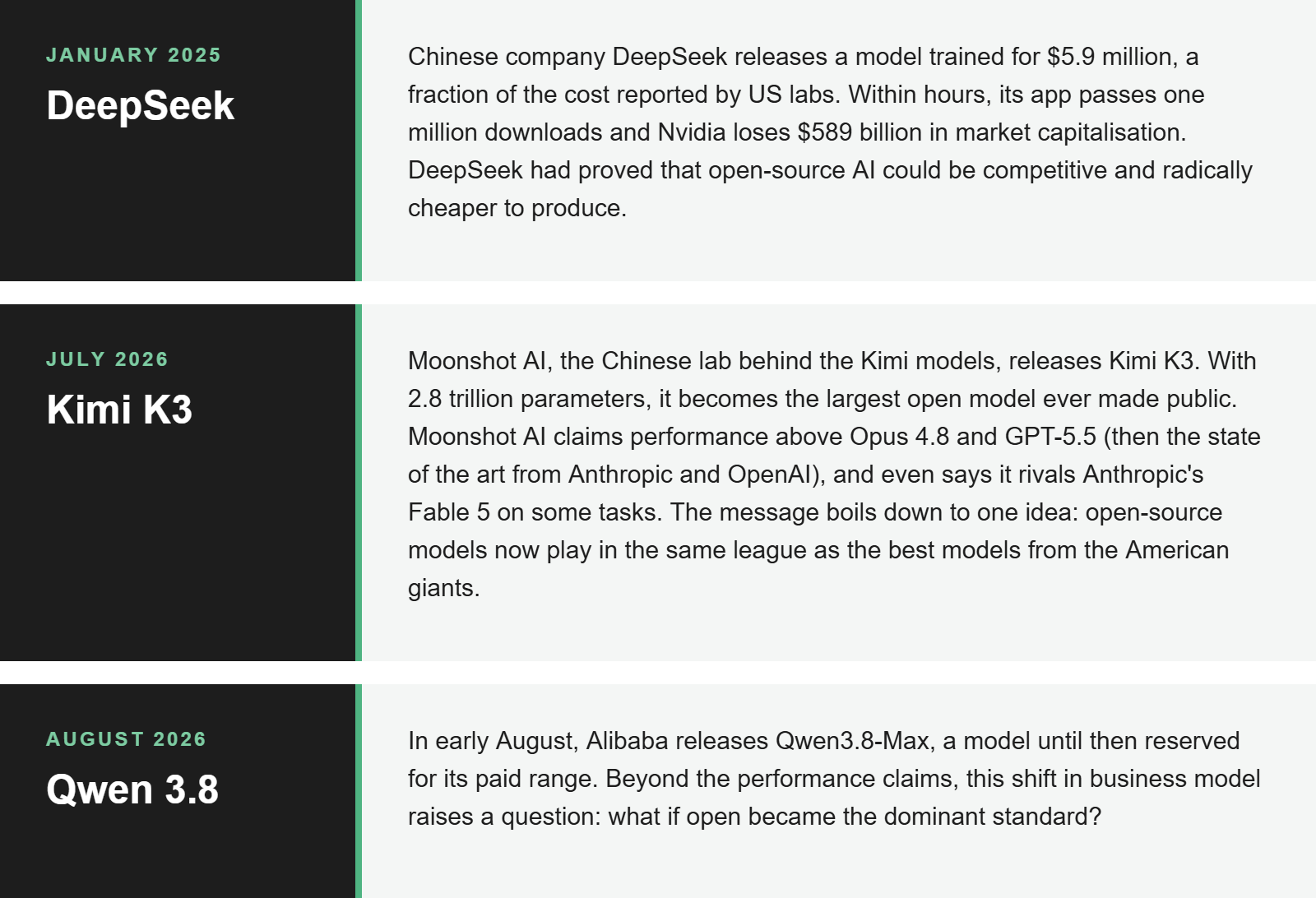
These three episodes set up a simple narrative, widely echoed in the press and on social media: open source has definitively caught up with proprietary AI on performance, and China is leading the race alone.
01 - Open source, open-weight: what are we really talking about?
Before going further, a clarification is needed. The models mentioned above are not "open source" in the strict sense, but "open-weight". In other words, only the trained parameters are public; the training data, code and methodology remain proprietary. Without access to that data, there is no way to tell whether benchmark scores reflect the model's real capabilities, or whether the company deliberately "contaminated" its model's training with the benchmark questions themselves.
The word "open" in AI also covers a broad spectrum of legal regimes. While some labs publish under the Apache 2.0 licence (fully permissive), their best models, such as Alibaba's Qwen3.8-Max, are often released under bespoke licences that require revenue sharing above a commercial-usage threshold.
02 - Open vs proprietary: has the gap really closed?
With these clarifications in place, the question remains: has open source caught up with proprietary AI?
Several websites that track benchmarks report a near-zero gap. Independent academic sources disagree: Stanford's AI Index 2026 measures the gap between the best closed model and the best open model growing from 0.5% in August 2024 to 3.3% in March 2026. Epoch AI puts the lag at four to six months of capability. Kimi K3 and Qwen3.8-Max were announced as leaderboard toppers by their own labs before release; after independent evaluation, they rank third and fourth respectively.
A gap that depends on the task
What's more, the real performance difference depends on the task being evaluated. On frontier tasks (mathematical reasoning, programming), closed models benefit from larger volumes of proprietary data, which also makes them stronger in languages other than English. They are also generally built with more guardrails, giving them better stability once in production.
China, the US, Europe: who leads in open?
That leaves the second assumption: that China completely dominates open models.
In spring 2026, Chinese open-weight models accounted for around 61% of tokens consumed on OpenRouter, and Llama, the American pioneer, had dropped out of the most-used model rankings.

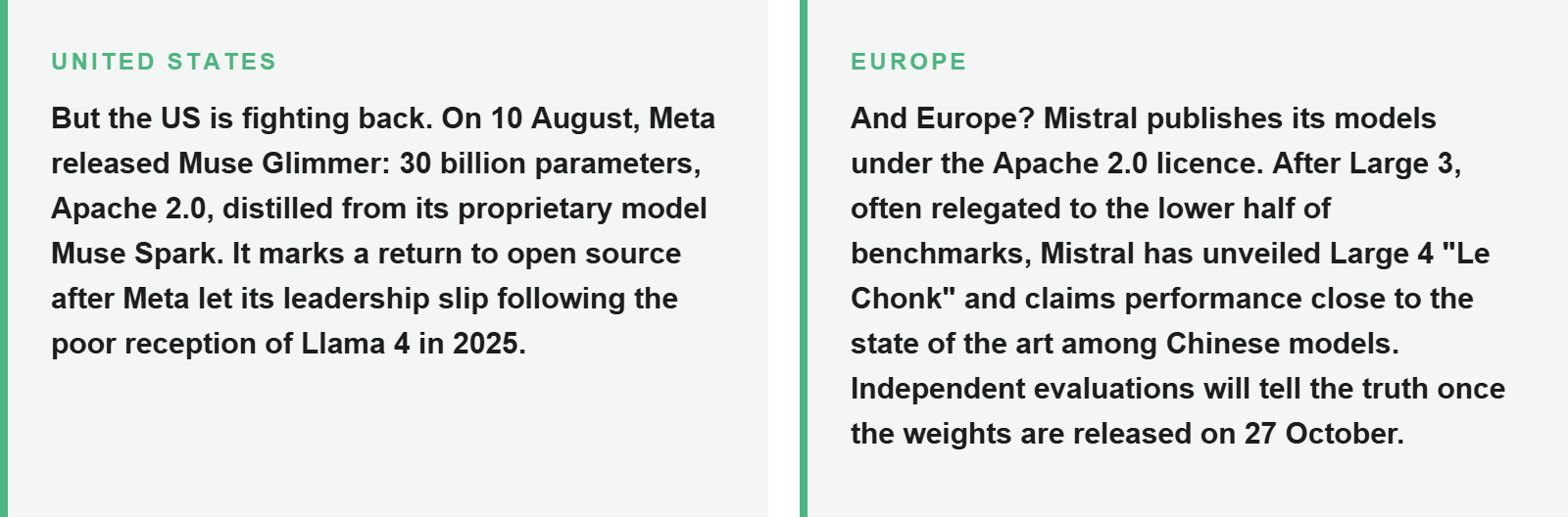
But the real battle among open models is not about benchmarks, nor a clash between two superpowers: it is about cost.
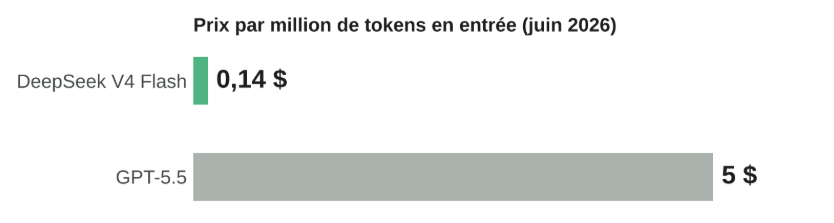
In June 2026, DeepSeek V4 Flash was priced at $0.14 per million input tokens, versus $5 for GPT-5.5. Uber cut its cost per AI session by 52% by combining open-weight models with intelligent request routing. Pinterest pays less than 8% of the cost of a comparable closed model by post-training open models on its proprietary data. AT&T cut its bill by 56% by replacing Claude with open source on tasks that don't require frontier reasoning, with only a 2% measured drop in quality.
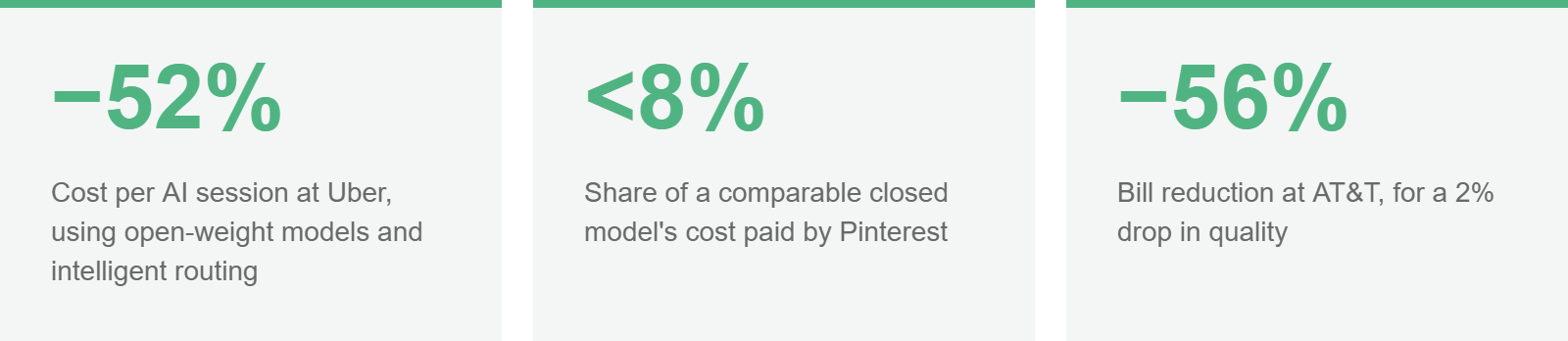
These companies haven't fully replaced proprietary models with open ones: they've added a routing layer between the application and the models, which classifies each request by complexity and sensitivity, then sends it to the cheapest model capable of handling it.
Open models therefore deliver real, measured savings in production. But where do these models run, and who is responsible for them?
In the vast majority of cases, companies don't deploy models on their own infrastructure. They go through third-party inference providers (Together, Fireworks, Groq), which host the open weights and bill by usage, just as a proprietary API from Anthropic or OpenAI would. The model's licence changes, but the way it is consumed stays the same.
SOVEREIGNTY
Finally, the question of control and access to data does not depend on the licence; it is the location and method of model deployment that determine who has access to what. Mistral, for example, deploys its own models directly on the infrastructure of clients in the defence sector, whereas most open models (Chinese or American) are accessed through a third-party API.
Sovereignty therefore depends on the combined choice of licence type and deployment location; using Mistral through a US inference provider is no more sovereign than using a Chinese model through a provider hosting it in the EU.
03 - Key takeaways
On-premise deployment is often presented as the path to sovereignty. But today it remains — still — the exception rather than the rule. According to Forrester, no major European commercial enterprise will fully do without US hyperscalers in 2026. Gartner, for its part, projects that 75% of companies will have a digital sovereignty strategy by 2030 (up from 5% in 2025). The mix of hyperscalers, sovereign players and self-hosting has yet to be worked out.
The question must therefore go well beyond "open or closed": a sound assessment must cover the total cost of the technical stack and vendor risk (who hosts the data? who can access it? how do you avoid lock-in? who bears responsibility? for which data / which use cases?). How do you find a solution that truly fits your company, taking all these dimensions into account? We'll answer that in our next article… stay tuned!
Open, proprietary or hybrid: which architecture is right for your business?
Real costs, data control, reversibility, accountability, dependency: eleven supports business leaders in defining their AI strategy. Let’s discuss your specific situation with Morand Studer, Partner, eleven