







Unlocking the value of data in agriculture

Unlocking the value of data in open field agriculture requires both reducing technological costs and identifying effective go to market strategies.
Over the course of their careers, farmers experience a limited number of crop cycles and seasons, roughly 60 years for those who spend their entire lives cultivating, to understand the agronomic dynamics of their fields, build expertise and adapt their practices over time.
This limited number of trials contrasts with a wide range of parameters that can be adjusted to increase yields : irrigation levels, fertiliser application, use of crop protection products, soil compaction, sunlight exposure, crop synergies and more. The virtually infinite combination of these variables makes decision making in agriculture highly complex.
In addition to this complexity, farmers must increase production to meet growing global food demand, expected to reach 8.5 billion people to feed by 2030 according to the Food and Agriculture Organization of the United Nations, while also facing a growing number of challenges such as soil depletion, water stress, regulatory and environmental constraints and rising input costs.
This complexity is further amplified by the unpredictable and uncontrollable nature of many of these parameters, particularly weather conditions. As a result, identical crop and management decisions do not always lead to the same outcomes. While this unpredictability can be mitigated in controlled environment agriculture, such as vertical farming or greenhouse cultivation, it remains a major challenge for open field farming, which still represents the vast majority of cultivated land worldwide.
Precision agriculture and AgTech : the promise of controlled complexity
This complexity, historically managed through generational experience and agronomic expertise, can now be addressed through technological innovation in open field agriculture. These innovations enable farmers to collect data on their immediate environment, including fields, crops and weather conditions, and to generate precise insights into crop needs.
This allows for improved yields while optimising resource allocation at the plant level. The convergence of these data driven technologies is commonly referred to as precision agriculture, currently driven by a wide range of players and technological solutions.
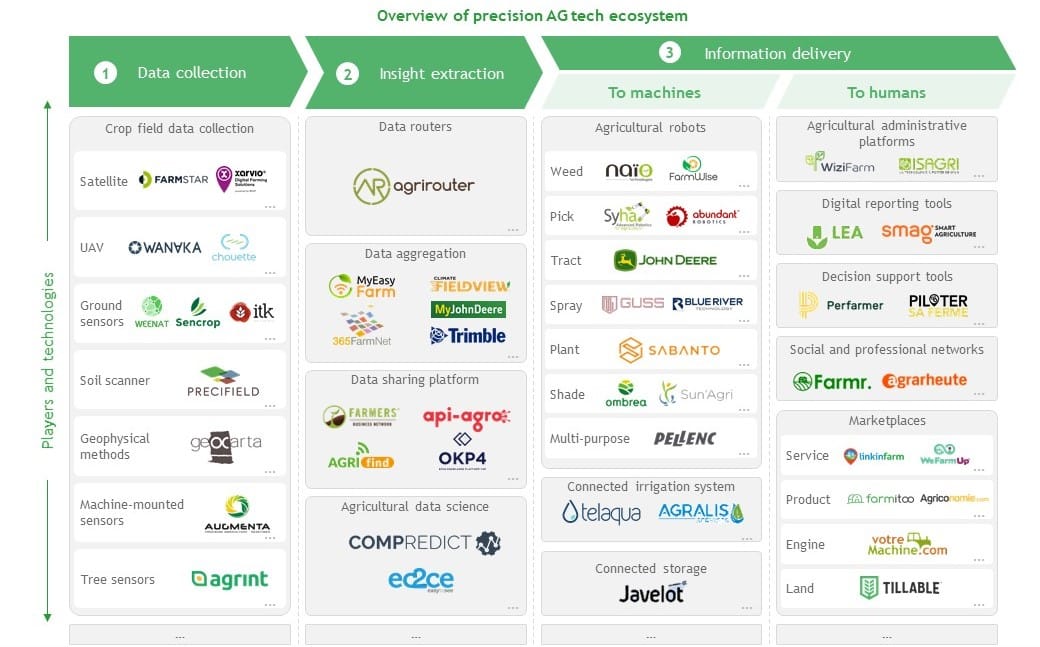
These technologies promise to support farmers in their decision making processes and daily operations by helping them select the optimal combinations among the many parameters they must consider, for example how much input to apply or how frequently to till the soil.
A widely adopted use case of precision agriculture is the automation of section control and variable rate application. Based on geolocation data, this approach connects GPS positioning systems to crop protection sprayers or seeders, enabling the avoidance of over application in specific field areas. According to Arvalis, a French agricultural institute, this technique can generate savings of up to €10 to €23 per hectare in crop protection products, depending on the crop and the farm.
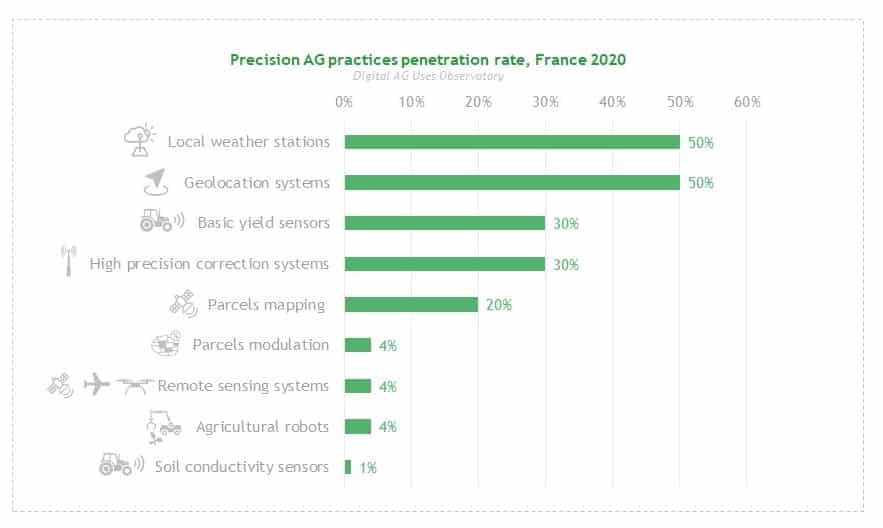
A wide range of technologies and decision support tools have been available for several years to help farmers better manage their operations. However, despite their visibility and long standing presence at agricultural trade shows, these technologies are still unevenly adopted.
While local weather stations and basic GPS systems have become widespread across most farms, more advanced technologies and techniques, such as variable rate application at the plot level, adjusting inputs and operations at plant level based on field variability maps, remain limited to a relatively small number of advanced farming operations.
Barriers to adoption and the commercial specificities of a fragmented sector
Several factors are slowing the broader adoption of agricultural and precision farming technologies, including data driven solutions. These challenges are both financial and related to go to market dynamics.
The first major barrier to innovation lies in the heterogeneity of fields and their limited comparability. Unlike indoor farming, where growing conditions are controlled and reproducible regardless of location, the agronomic diversity of outdoor fields is virtually infinite. This makes it difficult for technology providers to demonstrate a consistent and universal return on investment.
As a result, the burden of proof must be established repeatedly and at scale to demonstrate the value of a technological innovation to farmers. To date, many AgTech companies rely on specific use cases to demonstrate value, limiting their ability to generalise results beyond local conditions.
Beyond this challenge, AgTech solutions often require significant upfront investment for most farmers. Given these costs, the return on investment can remain uncertain, particularly in open field agriculture. This is largely due to the unpredictable and uncontrollable nature of key growth factors such as weather conditions, which makes it difficult to consistently reproduce results year after year, even with advanced technology in place.
Finally, the lack of support and training also contributes to slower adoption. While farmers are generally well connected and open to innovation, for example 71% own a smartphone and 72% use at least one agricultural application, their profession is both complex and time constrained.
Given the limited time available for technology monitoring, the AgTech landscape, with its wide range of fragmented solutions, remains difficult to navigate, further slowing down adoption.
Actionable levers to accelerate innovation adoption in agriculture
However, the challenges outlined above can be addressed, at least partially, through a combination of technical and commercial levers.
First, demonstrations of technological value must be conducted at scale and replicated locally to overcome the limited trust generated by isolated, field level experiments. These large scale demonstrations, carried out close to farmers, can be enabled through partnerships with local stakeholders to build credibility.
For example, in Brittany, the agricultural cooperative Terrena conducted an A B test of its variable rate technology across 4,000 fields, in partnership with the regional CUMA federation Ille Armor.
Beyond trust and value demonstration, several approaches can help reduce the cost of technologies. Greater frugality can be embedded by design in innovations to create more agile and cost efficient solutions.
For instance, certain use cases could be deployed by leveraging data and computing power from equipment already widely used on farms, such as smartphones or tractors, provided that partnerships are established with equipment manufacturers. Similarly, Kuhn has developed a free smartphone application, Kuhn Easy Maps, to help farmers navigate their fields and avoid overlaps during spraying operations.
Conversely, automation can also drive adoption by reducing service related costs. This is the promise of autonomous drones, such as those developed by American Robotics, which reduce operational costs by removing the need for human intervention.
In addition, non technical approaches can also contribute to lowering innovation costs through cost sharing mechanisms. Investments can be pooled among farmers via local collective organisations such as cooperatives, agricultural chambers or technical institutes, or shared with third parties.
For example, costs could be partially borne by insurance companies, as reduced risk exposure enabled by innovation may lead to lower premiums, or by local authorities, given the positive externalities for local communities.
Finally, part of the cost of innovation can be passed on to end consumers through higher prices, provided that investments demonstrably improve the environmental value of agricultural products and are supported by robust traceability.
In this respect, evolving consumer expectations around food and sustainability represent a positive signal for agricultural innovation, a trend already reflected in record levels of investment in the AgTech sector.