







Can algorithms be racist ?

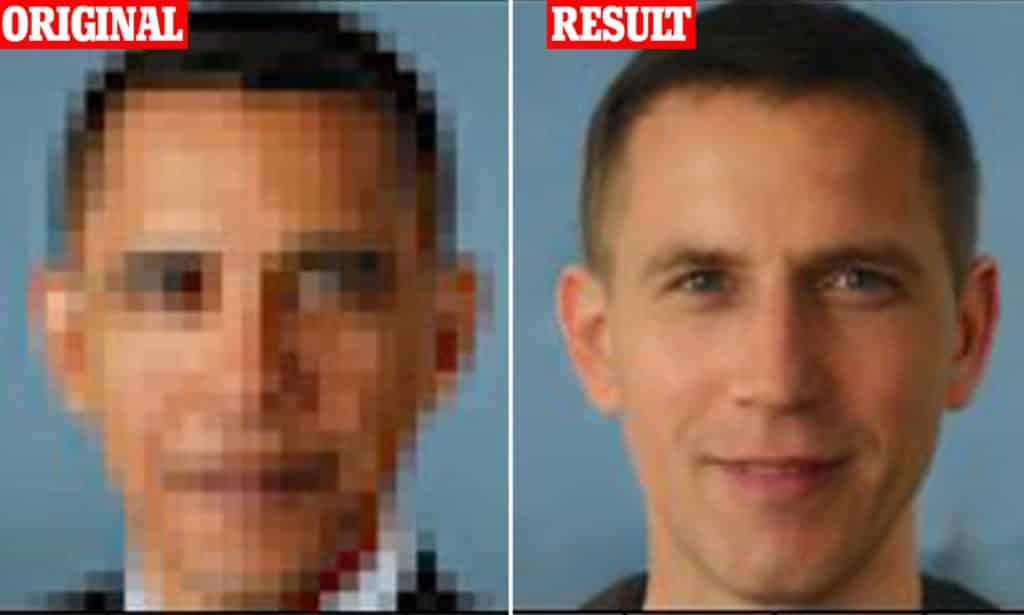
You have probably seen the image of Barack Obama, pixelated and then reconstructed by an algorithm. The result is quite far from the original and from what a human would imagine.
Indeed, a reasonably informed human can immediately recognise Barack Obama despite the poor quality of the image. Would a person who has never seen a photo of Barack Obama be equally surprised ? That is less certain.
Can we say that the algorithm is "racist" ? No, an algorithm has no emotions, no concept of humans or race. It is simply imperfect, sometimes inaccurate, and ultimately "biased".
What are these biases ?
Algorithms only reflect the data they are trained on. Typically, both the context, meaning the input data, and the outcome are required, either observed when discovering a rule or labelled when aiming to reproduce human behaviour. These datasets are often scarce and generally imperfect, therefore biased.
It is very difficult to obtain high quality and unbiased data. In theory, datasets would need to be fully representative of all possible conditions for the algorithm to learn effectively and generalise appropriately. In practice, algorithms struggle to handle unfamiliar situations, and performance tends to degrade when faced with scenarios that were not represented in the training data.
A classic example is survivorship bias. You may be familiar with the case of aircraft returning from combat with bullet holes. Where should the aircraft be reinforced ? The intuitive answer is to reinforce the areas that were hit. In reality, the opposite is true : the areas that were not damaged on the "surviving" aircraft should be reinforced, as damage in those areas likely caused other aircraft to crash, and are therefore not represented in the data.
When training a risk assessment algorithm, for example, there is a high probability that historical data does not include rejected cases. Training the model on such data may therefore lead to overlooking an "obvious" category of risk.
Similarly, if an algorithm is trained to replicate past human behaviour, it will also reproduce past errors. For instance, it is likely not advisable to train a self driving car to respect traffic lights solely based on the observed behaviour of thousands of drivers. A clear, rule based approach is probably more reliable.
These are technical biases. There is no notion of racism here, only errors, more or less visible and more or less significant. This is typically what happened with the reconstruction of Barack Obama’s image, where the algorithm was likely not trained on sufficiently robust or representative data.
Other, more nuanced biases are ethical biases.
There is no error here. The algorithm reflects a reality that we may choose to correct. For example, if a given ethnic group shows higher incidence of certain health conditions, an algorithm could recommend higher health insurance premiums. This may be technically accurate, but not necessarily desirable. As a result, the ethnic criterion may need to be excluded from premium calculations. However, it could remain relevant in a medical diagnostic context. This is an ethical decision, not a technical one, and it has little to do with Artificial Intelligence itself.
Removing an input variable is straightforward, and one of the advantages of algorithms is that they do not misrepresent their logic. While they can be complex to interpret, explainability methods exist to make their decision processes more transparent.
Humans, on the other hand, are at least as biased, if not more so, than algorithms. Cognitive biases are well documented and often operate unconsciously. Moreover, humans can misrepresent their reasoning and rarely acknowledge decisions made on flawed grounds.
Algorithms, by contrast, are more transparent and easier to analyse, provided the right tools and methods are applied. The key is to identify and address biases, whether technical or ethical, in a structured and measured way. It is important not to conflate these issues or amplify them through overly alarmist narratives.
Morand Studer
Sources : https://www.ulyces.co/denis-hadzovic/les-intelligences-artificielles-sont-racistes-voici-pourquoi/ https://fr.wikipedia.org/wiki/Biais_du_survivant