







MCP : the protocol paving the way for agentic AI in the enterprise
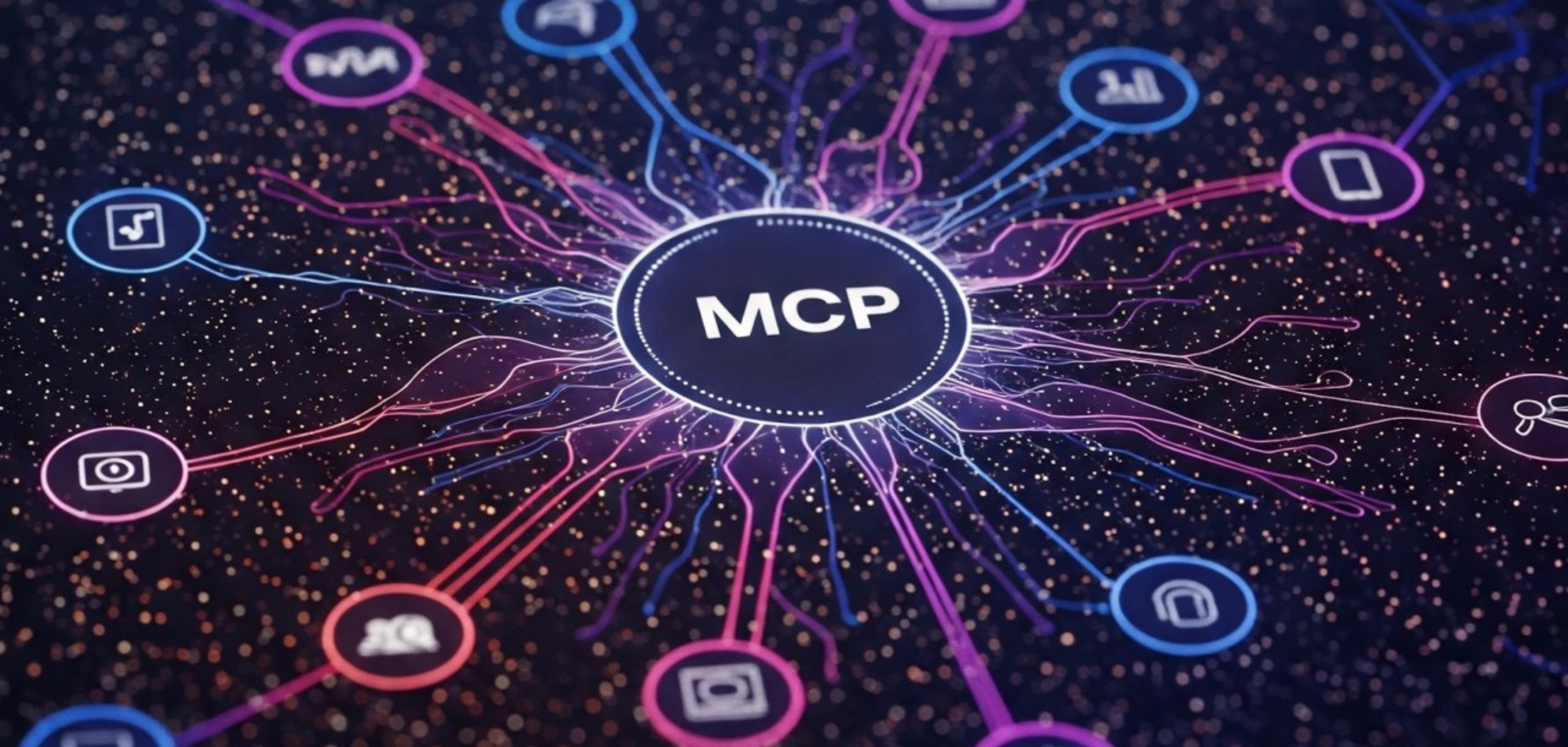
In recent months, so called agentic AI has been at the centre of discussions. This approach, which aims to develop intelligent agents capable of interacting autonomously with their environment, is built on a clear promise : making systems more adaptive, more autonomous and more efficient.
However, beyond the narrative, a key question is often overlooked : how can these AI agents communicate with each other, or with existing business systems, in a standardised and seamless way ?
This is precisely the role of MCP (Model Context Protocol)
MCP : a critical infrastructure layer
MCP is to AI agents what APIs have been to web systems. APIs (Application Programming Interfaces) enabled programs to communicate through well defined protocols, transforming how software integrates, automates and composes business tools.
MCP follows the same logic, but applies it to the world of AI agents. It introduces a dedicated communication protocol that allows agents to query each other, expose their capabilities, receive instructions and execute tasks autonomously, whether interacting with other agents or with external applications.
An agent therefore becomes queryable : it is possible to ask what it can do and dynamically send appropriate requests. This level of standardisation paves the way for more modular, reusable and easily orchestrated AI systems within complex environments.
From custom architectures to intelligent plug and play
Today, an agent’s ability to interact with its environment is highly dependent on the architecture in which it is deployed. Each integration is often specific, costly and difficult to maintain.
With MCP, the paradigm shifts towards a plug and play approach : each system exposes its capabilities, and each agent can connect to it without relying on manual integration layers. This fundamentally changes the scale at which AI can be embedded into business processes. It is no longer just about the model, but about the exchange infrastructure between agents and systems.
Within this framework, agents can interact more easily with software, data or other agents, without requiring redevelopment or redeployment each time. The system becomes more flexible, more dynamic and more scalable.
A structural transformation of information systems
What MCP enables is a deep transformation of information system architectures. The comparison with the transition from ESB architectures (Enterprise Service Bus) to APIs is particularly relevant.
In the past, systems communicated through a single central layer, a kind of technical switchboard. Each component had to go through this central bus to exchange information.
APIs disrupted this centralised model by enabling direct communication between systems, in a decentralised, more agile and more flexible way. This shift marked a major milestone in the modernisation of information systems.
MCP fits within this same disruptive dynamic. We are moving from a world of APIs to a world where systems expose MCP endpoints, and where an intelligent orchestrator can interact with all components through this protocol. This paves the way for a new generation of architectures based on distributed intelligent agents.
Why companies cannot ignore MCP
Some organisations are still transitioning from ESB based architectures to API driven models. However, for the most ambitious companies, or those already exploring agentic AI, it may be strategic to skip a step and move directly towards MCP oriented architectures.
Why ? Because MCP is a key enabler of agentic AI scalability. It allows agents to interact seamlessly without the need to build specific connectors for each use case. It standardises integration and simplifies governance in increasingly distributed systems.
In other words : without MCP, there is no industrialisation of agentic AI.
Conclusion : an infrastructure shift to anticipate now
MCP is neither a technical gimmick nor a passing trend. It represents a fundamental infrastructure evolution that could redefine how information systems interact with intelligent entities.
In a context where AI agents are rapidly multiplying, across business tools, value chains and customer interfaces, it is becoming essential to rethink how they are integrated.
Exploring MCP today means preparing information systems for the large scale adoption of agents, and ensuring that organisations do not miss the next major technological shift.